

Combined Eyebrow and Hair Transplant for Women
Combined Eyebrow and Hair Transplant for Women: In selected patients, an eyebrow and hair transplant for women can restore sparse eyebrows while lowering, reshaping, or increasing the density of the frontal hairline and temples. This article explains candidacy, feminine hairline design, combined harvesting methods, temporary shock loss, and recovery.
At a Glance: A combined procedure may be considered when a woman has a suitable donor area and stable hair loss without diffuse thinning. Treatment can include the eyebrows, frontal region, and temples, usually in one day. The method depends on the treatment area and whether the patient wants to keep her donor hairs long. MFUE, MFUT, or a combination of MFUE for the scalp and MFUT for the eyebrows may be used after individual assessment.
What Is a Combined Eyebrow and Hair Transplant?
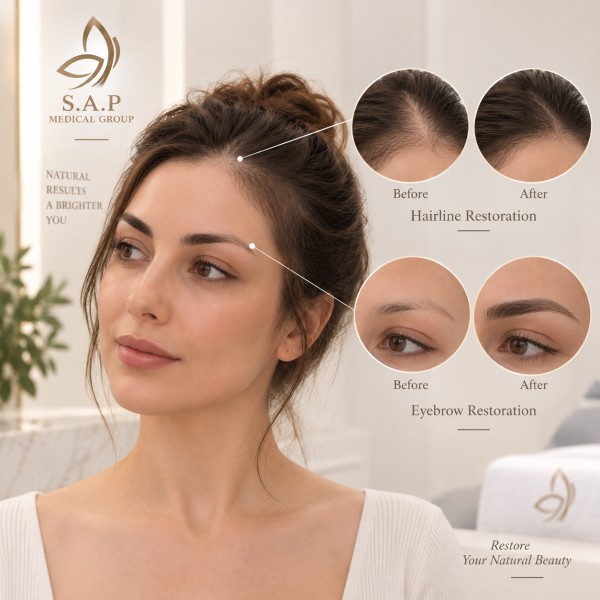
An eyebrow and hair transplant for women addresses two visible areas within one plan. The eyebrow component may reconstruct missing sections, improve symmetry, cover suitable scars, or increase density. The scalp component focuses on a selected frontal area and may lower a high hairline, fill the temples, reshape the hairline, or add density between existing hairs.
At S.A.P, the objective is not to cover every thin part of the scalp. Treatment generally concentrates on a frontal zone approximately equal to the breadth of the patient’s own four fingers, including the temples when necessary. Even if thinning extends farther back, transplanting a larger area is not always recommended. A carefully selected area protects the donor supply and supports visual balance.
- Naturally high or disproportionate foreheads
- Temporal recession or an uneven frontal hairline
- Stable thinning limited mainly to the front of the scalp
- Hair loss caused by long-term traction or tight hairstyles
- Selected stable scars from surgery, injury, or burns
- Missing, sparse, asymmetrical, or previously damaged eyebrows
- A healthy donor area with sufficient density and suitable hair quality
- Realistic expectations about density and the limits of transplantation
Assessment includes the pattern and activity of hair loss, donor quality, skin condition, medical history, previous procedures, and the risk of future thinning.
Who May Be a Suitable Candidate?
When Is Transplantation Not Recommended?
A woman with diffuse hair loss is generally not a suitable candidate, even for eyebrow transplantation alone. Diffuse thinning may affect both the visible scalp and donor area, leaving an unreliable supply of healthy follicles.
Other reasons to postpone or avoid surgery may include active or severe hair loss, an inadequate donor area, untreated inflammatory scalp disease, unsuitable scar tissue or skin condition, and expectations that would require an unnatural hairline or unrealistic density.
Severe hair loss should usually be treated and stable for at least six months. Some patients must begin medical treatment and wait before surgery; in selected cases, treatment may begin at the time of transplantation. The decision requires clinical assessment.
Designing a Natural Female Hairline
The success of an eyebrow and hair transplant for women depends heavily on design. A feminine hairline is not simply a straight line moved downward. It must relate to the entire face and remain believable with different expressions and hairstyles.
The team evaluates forehead height, head size, temple depth, the relationship between lips and chin, eyebrow position, and overall facial balance. The patient’s own four-finger measurement is a personal reference, not an isolated rule.
Raising the eyebrows reveals dynamic forehead lines and mobile skin. Hair should not be placed over active forehead creases merely to create the shortest possible forehead, because ignoring facial movement may produce an unnatural result.
Ethnic and national background can influence natural hairline characteristics. Patterns commonly seen in women of African heritage, for example, may differ from those seen in Russian or Northern European women. These are not rigid stereotypes; design must also consider the patient’s original hair pattern, facial structure, preferences, and earlier photographs.
Eyebrow Design Must Be Planned Separately
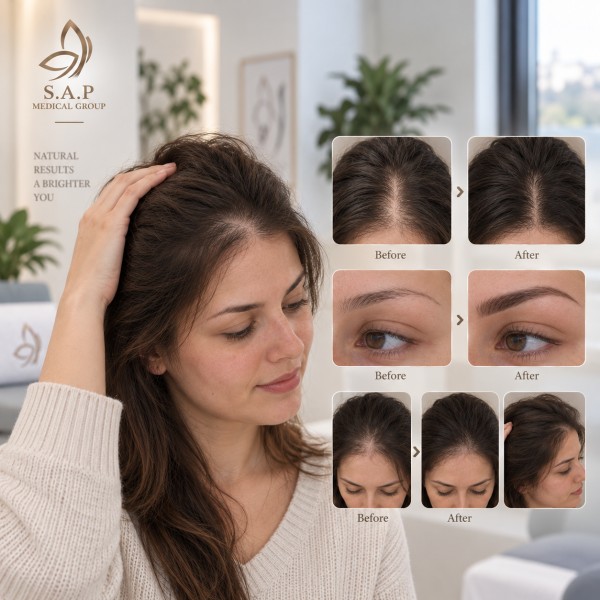
Although the procedures may be combined, eyebrows and scalp hairlines follow different design rules. Eyebrow hairs require careful control of thickness, direction, angle, and placement, while the shape must suit the eyes, face, existing hairs, and preferred style.
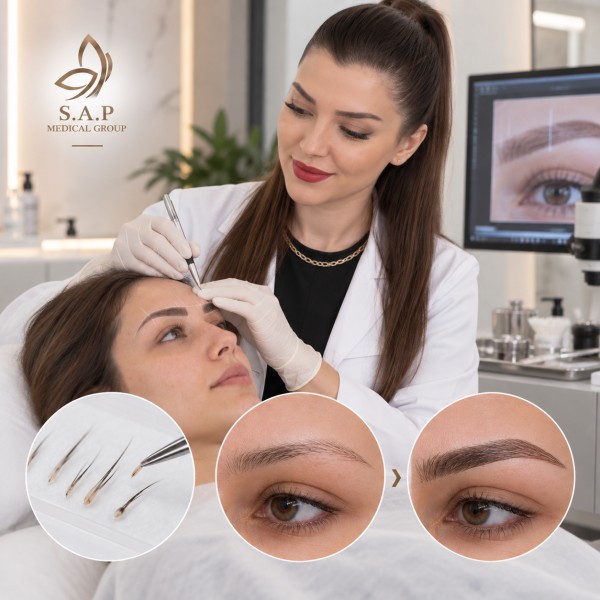
Eyebrow grafts may be examined and refined under a microscope. Finer hairs are used where softness is needed, while compatible thicknesses can be mixed to avoid separated blocks of fine and coarse hair.
Choosing MFUE, MFUT, or a Combined Method
There is no single harvesting method for every eyebrow and hair transplant for women. Selection depends on donor quality, treatment size, tolerance for trimming, and whether long hair shafts are important.
If a patient accepts shortening part of the donor area, MFUE may be used for the scalp. Between existing scalp hairs, DHI can place grafts with limited disturbance. At S.A.P, this plan may combine MFUE harvesting, microscopic graft organization, and DHI implantation. DHI describes implantation, not harvesting.
If the patient wants to preserve long hairs and the combined treatment requires a substantial donor supply, MFUT is generally more appropriate. Long FUE is not usually selected for a high graft requirement because it is better suited to more limited needs.
Methods can also be combined: MFUE for the scalp when shorter donor hairs are acceptable and MFUT for long-haired eyebrow grafts. The longer shafts make the eyebrow design visible immediately after placement.

Simple Method Comparison
Possible plan: Selected frontal and eyebrow restoration may be planned together
Possible plan: MFUE may be used for the scalp
Possible plan: DHI may be used for scalp implantation after graft preparation
Possible plan: MFUT is generally more suitable than Long FUE
Possible plan: MFUE for the scalp and MFUT for the eyebrows may be combined
Possible plan: Transplantation is generally postponed or not recommended
Can Existing Hair Be Affected by Shock Loss?
When grafts are implanted between a woman’s existing frontal hairs, DHI can reduce unnecessary disturbance, but it cannot eliminate every possibility of temporary shock loss. Some natural hairs may enter a resting and shedding phase after the procedure, together with the transplanted hair shafts. This does not affect every existing hair and does not automatically indicate permanent loss.
In many patients, temporarily shed natural hairs return before visible growth from transplanted follicles begins. Transplanted shafts commonly shed during the early weeks and grow later. Explaining this sequence prevents unnecessary concern, although unusual or persistent loss requires individual assessment.
Why Plan Both Areas Together?
Planning an eyebrow and hair transplant for women as one coordinated treatment helps the team evaluate the eyebrows, forehead, temples, and donor supply as parts of the same visual balance. It may also reduce the need for separate preparation and recovery periods.
However, convenience must never override safety or donor preservation. Combining procedures is valuable only when both areas are suitable for transplantation and the planned workload can be completed without compromising graft handling, patient comfort, or the overall quality of placement.
Is the Combined Procedure Completed in One Day?
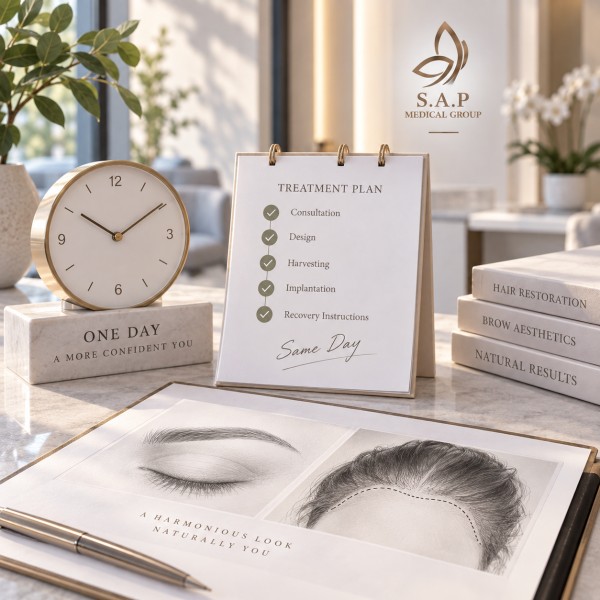
For women, an eyebrow and hair transplant for women is usually completed in one day because treatment focuses on the eyebrows and a selected frontal area. This creates one coordinated plan and early recovery period.
However, one day cannot be guaranteed before assessment. The schedule depends on the treatment areas, donor characteristics, methods, eyebrow complexity, patient comfort, bleeding, blood-pressure changes, and clinical response. If continuing is not advisable, one portion may be completed another day.

Recovery After Combined Treatment
Both areas need protection during early healing. Avoid touching, scratching, rubbing, or sleeping on the grafts. Keep the head elevated and follow the clinic’s washing, medication, and donor-care instructions.
Temporary redness, small crusts, mild swelling, shedding, and shock loss may occur. The exact instructions can vary according to whether MFUE, MFUT, or a combined method was used. Patients should contact the clinical team if they experience worsening pain, significant redness, discharge, heavy bleeding, or other unusual symptoms.
Growth develops gradually as follicles pass through resting and growth phases. Follow-up photographs help monitor the eyebrows, hairline, temples, and donor area.
Why Choose
SAP Medical Group
in Istanbul?
- Expert SpecialistsDecades of combined eyebrow transplantation experience.
- Advanced TechnologyMicro-punch tools for precise, scar-free extraction.
- International Patient CareMultilingual team support at every step.
- Affordable PackagesHigh-quality treatments at globally competitive rates.
- Proven Results Real patient transformations available in our gallery.
Is Combined Treatment Right for You?
An eyebrow and hair transplant for women can be a valuable option for a suitable patient who wants to improve two highly visible areas through one coordinated plan. The best candidates have stable, localized concerns, healthy donor hair, suitable skin, and realistic expectations.
A responsible plan considers the cause and stability of hair loss, donor capacity, facial proportions, natural ethnic characteristics, forehead movement, existing eyebrow hairs, and preferences regarding donor-hair length.
At S.A.P, the priority is not to transplant the largest possible area. It is to select an appropriate area, protect the donor supply, design a natural feminine hairline, and choose the safest practical combination of techniques for each individual woman.
No comment