


Eyebrow Transplant Healing Stages
Eyebrow Transplant Healing Stages: What to Expect During Recovery
An eyebrow transplant is a permanent solution for people with thin, sparse, overplucked, or scarred eyebrows. Unlike temporary cosmetic options such as makeup, microblading, or tattooing, Eyebrow Transplant in Istanbul, Turkey restores natural hair that continues to grow throughout life.
One of the most common concerns patients have before surgery is the healing process. Questions such as *"How long does healing take?"*, *"When will the redness disappear?"*, and *"Is shedding normal?"* are asked almost every day.
Understanding the eyebrow transplant healing stage helps patients feel more confident and prepared throughout recovery. Although every person heals at a slightly different pace, the overall healing process follows predictable stages.
In this guide, you'll learn what to expect during every phase of recovery—from the first day after surgery to the final results one year later. We'll also explain what is considered normal, what factors influence healing, and how proper aftercare can help achieve the best possible outcome.
What Are the Main Eyebrow Transplant Healing Stages?
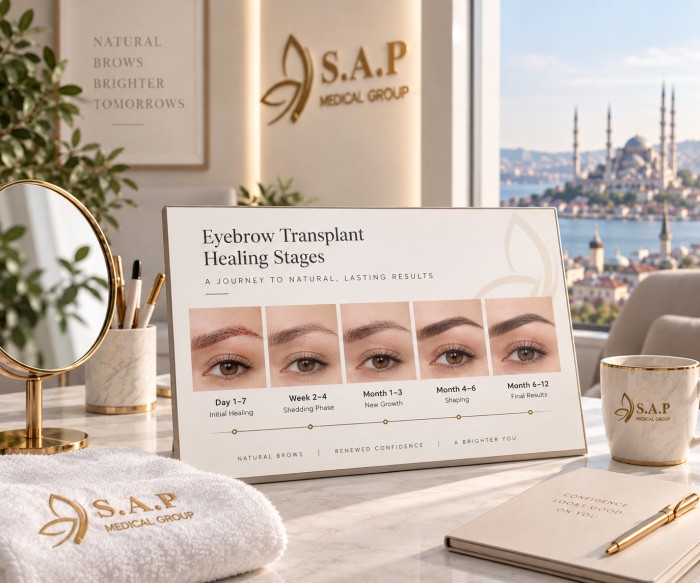
Although every patient heals differently, eyebrow transplant recovery generally follows five main stages:
• Initial healing (Days 1–7)
• Scab formation and crusting
• Temporary shedding (Shock Loss)
• New hair growth
• Final maturation and results
Each stage plays an important role in achieving natural, healthy, and long-lasting eyebrows.
Stage 1: Initial Healing (Days 1–7)
The first week is when your body begins repairing the tiny implantation sites created during the procedure.
It is completely normal to experience:
• Mild redness around the transplanted area
• Slight swelling, especially around the eyelids
• Small scabs surrounding each implanted follicle
• Mild tightness or tenderness
These reactions are signs that the body's natural healing process has begun.
At S.A.P Medical Group, both the donor and recipient areas are treated using minimally invasive techniques designed to minimize unnecessary trauma. As a result, most patients can return to their normal daily activities within a relatively short time.
During this stage, it is essential to follow all post-operative instructions carefully. Patients should avoid rubbing or scratching the eyebrows, keep the area clean, and follow the washing routine recommended by their surgeon to support healthy healing.
Stage 2: Scabbing and Crusting (Days 5–14)
Scab formation is one of the most important—and completely normal—eyebrow transplant healing stages. Small crusts develop around each transplanted follicle as the skin naturally repairs the microscopic implantation sites.
These scabs protect the newly implanted grafts while the surrounding tissue heals. Most begin to loosen during the first week and fall off naturally by the end of the second week.
During this period, patients should never scratch, pick, or forcefully remove the scabs, as doing so may interfere with healing or damage newly implanted follicles. Gentle washing, following the surgeon's instructions, helps soften the crusts so they detach naturally.
It is also common for the eyebrows to appear darker or thicker during this stage because the scabs remain attached to the hair shafts. Once the crusts disappear, the eyebrows gradually begin to look more natural.
The donor area usually heals even faster than the recipient area, with the tiny extraction sites closing quickly and leaving little to no visible evidence that hair was harvested.
Stage 3: Shedding (Shock Loss) (Weeks 2–8)
One of the most misunderstood stages of recovery is Shock Loss.
Many patients become concerned when the transplanted hairs begin to fall out a few weeks after surgery. However, this is a completely normal part of the healing process and does not mean the transplant has failed.
During this phase, only the hair shafts shed while the transplanted follicles remain safely beneath the skin. The follicles then enter a temporary resting phase before producing new hair.
The amount of shedding varies from patient to patient. Some individuals lose nearly all transplanted hairs, while others retain part of their eyebrows throughout recovery. Both situations are considered completely normal.
Several factors may influence this stage, including:
• Individual healing characteristics
• Blood supply to the skin
• Previous eyebrow tattooing or microblading
• Existing scar tissue
• Overall skin quality
At S.A.P Medical Group, every patient's skin is carefully evaluated before surgery because conditions such as previous microblading, laser tattoo removal, burns, or scar tissue can influence both healing and early hair growth.
Understanding this stage helps patients remain patient and confident while waiting for the transplanted follicles to become active again.
Stage 4: New Hair Growth (Months 3–6)
After the temporary shedding phase, the transplanted follicles gradually become active again. This marks one of the most exciting eyebrow transplant healing stages, as patients begin to see new eyebrow hairs emerging from the skin.
New hair growth usually starts around the third month after surgery, although the exact timing varies from person to person. Some patients notice fine hairs slightly earlier, while others may not see significant growth until the fourth month. Both timelines are considered completely normal.
During the early growth phase, the new hairs are often:
• Fine and soft
• Light in color
• Slightly uneven in length
• Growing at different speeds
Each transplanted follicle follows its own natural growth cycle, so the eyebrows become fuller gradually rather than all at once.
Because the transplanted hairs are typically taken from the scalp, they continue to grow longer than natural eyebrow hairs. Regular trimming becomes part of normal eyebrow maintenance after the transplant.
At S.A.P Medical Group, patients receive detailed guidance on trimming and shaping their new eyebrows correctly to maintain a natural appearance as the hairs continue to mature.
Although visible improvement begins during this stage, the eyebrows are still developing and do not yet represent the final outcome.
Stage 5: Final Results (Months 9–12)
The final stage of eyebrow transplant healing occurs between nine and twelve months after the procedure. By this time, most transplanted follicles have completed their healing process and are producing healthy, permanent hair.
The eyebrows gradually become:
• Fuller
• Softer
• More natural in appearance
• Better integrated with the surrounding hairs
Hair texture also improves over time. Initially fine hairs become stronger, while overall eyebrow density continues to increase as more follicles complete their growth cycles.
Although most patients achieve their desired appearance within one year, minor improvements may continue for several additional months depending on individual healing characteristics.
A successful eyebrow transplant should blend naturally with the patient's facial features, eyebrow shape, and natural hair direction. Long-term success depends not only on the procedure itself but also on careful planning, precise graft placement, and the surgeon's experience.
Factors That Affect the Healing Process
Although the healing stages follow a similar pattern for most patients, recovery is never exactly the same for everyone. Some patients experience minimal redness and rapid healing, while others require more time before their skin fully recovers. Several factors can influence how quickly and smoothly the healing process progresses.
Technique Used
Aftercare Routine
Individual Healing Response
Common Myths About Eyebrow Transplant Healing
Many patients search online for information about eyebrow transplant recovery, but not everything they read is accurate. Misunderstanding the healing process can lead to unnecessary concern during recovery. Understanding the facts helps patients maintain realistic expectations.
Myth 1: Hair Shedding Means the Transplant Failed
This is one of the most common misconceptions. Temporary shedding, also known as shock loss, is a normal part of the healing process. In most cases, only the hair shafts fall out while the transplanted follicles remain safely beneath the skin. New hair growth typically begins a few months later.
Myth 2: Healing Should Be the Same for Everyone
Every patient heals at a different pace. Factors such as age, skin quality, circulation, previous cosmetic procedures, and overall health all influence recovery. Comparing your progress with someone else's experience is often misleading.
Myth 3: Faster Healing Means Better Results
Healing speed does not determine the final outcome. Patients who heal more slowly can achieve results that are just as successful as those who recover quickly. Proper surgical technique, careful aftercare, and patience are far more important than the speed of recovery.
Myth 4: Once the Skin Heals, the Final Result Is Complete
Although the skin usually recovers within the first few weeks, the transplanted follicles continue developing beneath the surface for several months. The final eyebrow density, texture, and appearance typically become visible between 9 and 12 months after surgery.
Tips for a Smooth Healing Process
While healing is largely controlled by the body's natural repair mechanisms, patients can support recovery by following a few simple recommendations:
- Follow all post-operative instructions carefully.
- Avoid touching, rubbing, or scratching the transplanted eyebrows.
- Allow scabs to fall off naturally without picking them.
- Take prescribed medications exactly as directed.
- Protect the eyebrows from excessive sunlight during the early healing period.
- Maintain a healthy diet, stay well hydrated, and get adequate sleep.
- Avoid smoking whenever possible, as it may slow tissue healing.
- Attend all scheduled follow-up appointments so your surgeon can monitor your progress.
Most importantly, remain patient. Eyebrow transplantation is a gradual process, and the most natural results develop over time rather than immediately after surgery.
When to Contact Your Surgeon
Most symptoms experienced during the eyebrow transplant healing stages are completely normal and improve without treatment. Mild redness, swelling, small scabs, itching, and temporary hair shedding are expected parts of the recovery process.
However, patients should contact their surgeon if they experience:
• Increasing pain that does not improve with prescribed medication
• Excessive swelling that continues to worsen
• Persistent bleeding from the donor or recipient area
• Yellow or green discharge from the transplant site
• Fever or other signs of infection
• A foul odor coming from the treated area
• Severe redness spreading beyond the transplant area
• Any unexpected changes that cause concern
Early communication with the medical team allows potential problems to be evaluated promptly and treated if necessary. Patients should never attempt to self-treat suspected complications without professional advice.
Conclusion
Understanding the eyebrow transplant healing stages helps patients approach recovery with realistic expectations and greater confidence. Every stage—from the first few days after surgery to the appearance of the final results—plays an important role in achieving natural, long-lasting eyebrows.
Although temporary redness, scabbing, and hair shedding may seem concerning at first, these are normal biological responses and an expected part of the healing process. Patience is essential, as new hair growth develops gradually over several months before the final result becomes visible.
Successful healing depends on several factors, including the surgical technique, the patient's individual healing response, and careful adherence to post-operative instructions. Choosing an experienced eyebrow transplant team can significantly improve both the recovery experience and the final aesthetic outcome.
At S.A.P Medical Group, every treatment plan is tailored to the individual patient. From the initial consultation through long-term follow-up, our team focuses on precise surgical planning, natural eyebrow design, and comprehensive aftercare to help patients achieve safe healing and natural-looking, permanent results.
If you are considering an eyebrow transplant and would like to learn more about the healing process or receive a personalized assessment, our specialists are available to answer your questions and guide you through every stage of your journey.
Why Choose
SAP Medical Group
in Istanbul?
- Experienced SpecialistsExperts with extensive eyebrow and hair transplantation experience.
- Advanced TechnologySpecialized microscopes and delicate tools for precision.
- Multilingual SupportDedicated team assisting international patients.
- Affordable ExcellenceHigh-quality treatment at competitive prices.
- Proven TransformationsExplore our gallery to see real MFUT results.
Ready to Transform Your Eyebrows?
Scheduling the Procedure First, you need to send photos of your eyebrows and the back of your head. Our consulting team will explain all the details to you. To fill out the consultation form, the doctor will ask you some questions, please answer them carefully. After reviewing your request form, if there are no contraindications, a procedure appointment will be scheduled according to your request.
No comment