


Eyebrow Transplant Results by Month
Eyebrow Transplant Results by Month: Complete Growth Timeline
Eyebrow transplantation does not produce its final result overnight. Although patients who undergo a long-hair eyebrow transplant can see their planned eyebrow design immediately after the procedure, the transplanted follicles then enter an individual healing and growth cycle before the permanent result develops.
Understanding Eyebrow Transplant Results by Month is important because the appearance of the eyebrows can change considerably during the first year. Hair may shed unevenly, one eyebrow may grow faster than the other, and some patients may experience very little visible growth for several months before the eyebrows begin developing more noticeably.
At S.A.P, we advise patients not to judge their final result too early. Based on typical clinical experience, a patient may see approximately half of the expected growth by six months, around 80% by eight months, and a near-final result between months 10 and 12. However, the Eyebrow Transplant Timeline can vary significantly between individuals.
This guide explains what patients can realistically expect throughout the important stages of eyebrow transplant growth.
How Long Does It Take to See Eyebrow Transplant Results?
One of the most common questions patients ask is: When will I see my eyebrow transplant results?
With a long-hair eyebrow transplantation technique, the planned eyebrow design can be seen immediately after surgery because the transplanted hairs remain long enough to show their direction, shape, and coverage.
However, the eyebrows may initially appear darker and denser due to wet hairs, minor postoperative fluid or blood, and mild swelling. As healing progresses, the appearance becomes more natural, and patients can eventually trim and style the transplanted hairs.
The immediate postoperative appearance should not be confused with the final eyebrow transplant result. The biological growth process takes much longer, with new growth generally beginning gradually around the third month after shedding.
A typical timeline is:
- Month 3: Early new growth begins
- Month 6: Around 50% of expected growth may be visible
- Month 8: Approximately 80% may be visible
- Months 10–12: The result approaches maturity
These figures are general clinical estimates, not fixed deadlines. Some patients experience faster growth, while others may show limited growth at six months and develop significantly during the following months.
Eyebrow Transplant Results: First Week
The Eyebrow Transplant First Week is primarily a healing period.
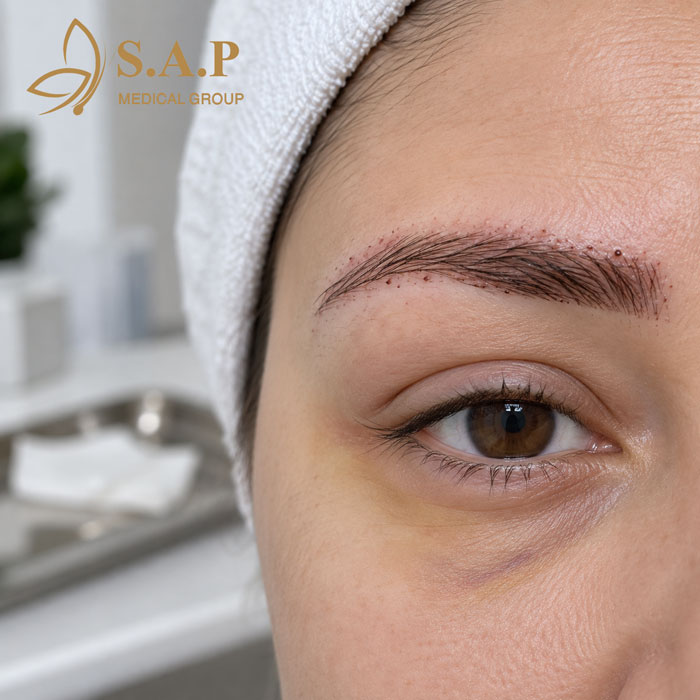
Interestingly, many patients experience little or no obvious swelling immediately after surgery. Swelling may gradually move downward, meaning that heaviness around the upper eyelids can become more noticeable the following morning. The second and third days can produce the most noticeable eyelid swelling.
Some patients may also develop a very thin line of bruising around the eye, while others experience almost no visible discoloration. The eyebrow design itself generally remains unchanged.
With the eyebrow transplantation protocol used by S.A.P, heavy crust formation is not considered a normal feature of the technique. Redness is also generally limited. Some patients may experience mild redness around the eyebrows, while others may temporarily appear pale immediately after treatment because of medications used during the procedure.
The first week should therefore be viewed primarily as a period of protecting the newly implanted follicles rather than evaluating the final cosmetic appearance.
What Do Eyebrow Transplant Week 1 Results Look Like?
With long-hair transplantation, the implanted hairs remain visible throughout the first week and may continue growing according to the patient's individual hair biology.
Patients often ask: Can I trim my eyebrows now? We generally recommend patience.
Although the hairs can become longer than a normal eyebrow during the first week, the early days are primarily about protecting the newly implanted grafts.
Patients should generally wait until approximately Day 12 before freely trimming and manipulating the eyebrows according to their postoperative instructions.
Around Day 12, eyebrow care becomes much more normal.
Patients can usually:
- Wash the eyebrows thoroughly
- Shower normally
- Gently massage the eyebrows
- Comb the hairs with an eyebrow brush
- Trim longer hairs
For patients whose donor technique required sutures, approximately Days 12–14 may also be the appropriate period for suture removal depending on their individual surgical instructions.
After washing, combing, and trimming, many patients see one of the clearest early representations of their intended eyebrow shape.
However, another important stage is about to begin: Shedding.
Eyebrow Transplant Results After One Month
Eyebrow Transplant Result: Month 1 can be psychologically confusing.
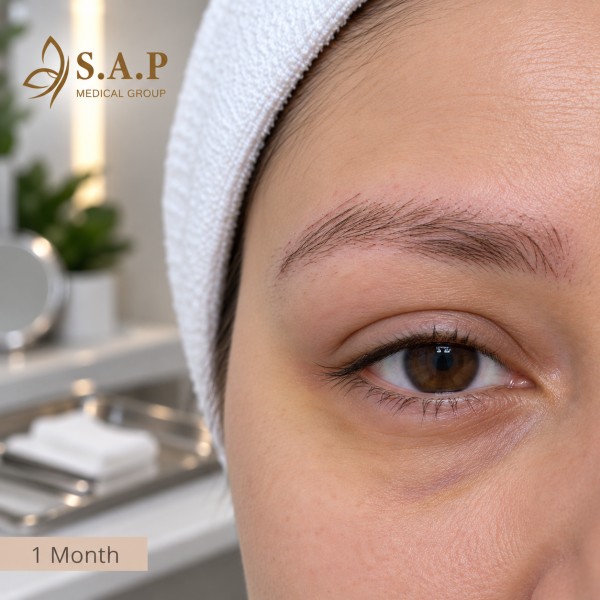
An eyebrow that looked relatively full immediately after surgery may gradually become sparse again as the transplanted hairs enter their temporary shedding phase. Shedding varies considerably between patients.
For some patients, most shedding occurs during the first two weeks. For others, shedding continues throughout the first month.
Some patients lose only a small percentage of their transplanted hairs, while others lose most of the visible hair shafts.
Occasionally, patients become concerned for the opposite reason and ask why their transplanted hairs have not fallen out. Both patterns can occur.
Some transplanted follicles continue their growth cycle without significant visible shedding. This does not necessarily mean that their eventual result will be better; it simply means that their individual growth timeline is different.
Does Shedding Mean the Graft Has Fallen Out?
This is one of the biggest concerns during Eyebrow Transplant Results After One Month.
Once the graft has stabilized, the hair that sheds is generally the visible hair shaft rather than the transplanted follicle itself.
Patients sometimes collect fallen hairs on a tissue because they are afraid that they have lost their grafts.
What they usually see is simply the hair shaft rather than an entire follicular unit. By approximately Day 12, the implanted follicle has become established within the tissue. Normal washing and subsequent shedding should therefore not be confused with physically losing the transplanted follicle. At the end of the first month, the two eyebrows can also temporarily appear asymmetrical.
One eyebrow may retain more visible hairs, while the other may shed considerably more. Even different areas of the same eyebrow can behave differently.
Once permitted by the medical team, patients may use eyebrow pencils, powders, or appropriate styling products to temporarily camouflage sparse areas while waiting for new growth.
Eyebrow Transplant Results After Three Months
Between the end of Month 1 and the beginning of new growth, some patients enter a stage that can feel like a “bald” phase. For someone who had very little or no natural eyebrow hair before transplantation, this period may temporarily resemble their pre-operative appearance.
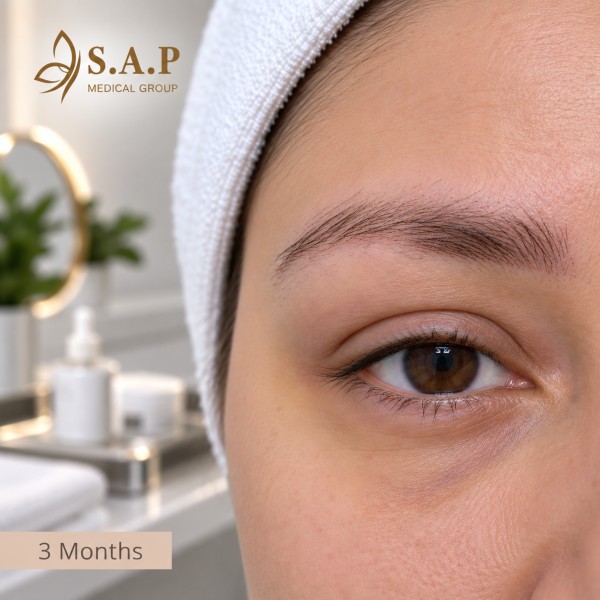
This is not evidence that the procedure has failed. Around the third month, Eyebrow Hair Growth After 3 Months usually begins gradually rather than all at once. The earliest new hairs can be extremely fine.
Patients may initially notice only a few scattered hairs.
As time passes, additional follicles begin producing new hairs, and the early hairs gradually become thicker and more noticeable.
Growth is not synchronized. One follicle may begin growing while another remains dormant for several additional weeks. This is why the eyebrows may temporarily look uneven or incomplete during the early growth stage. Temporary asymmetry is therefore possible and does not necessarily indicate a problem.
Patients can comb and style the developing hairs. If sparse areas are cosmetically bothersome, eyebrow makeup can also be used to create a more balanced appearance while waiting for growth to mature.
Most importantly, six months is generally too early to rush into a touch-up procedure. Viable follicles may still be present beneath the skin without producing visible hairs. Implanting additional grafts prematurely can interfere with an area that has not yet completed its natural growth cycle. At S.A.P, we prefer to allow the full growth period to develop before deciding whether additional transplantation is genuinely necessary.
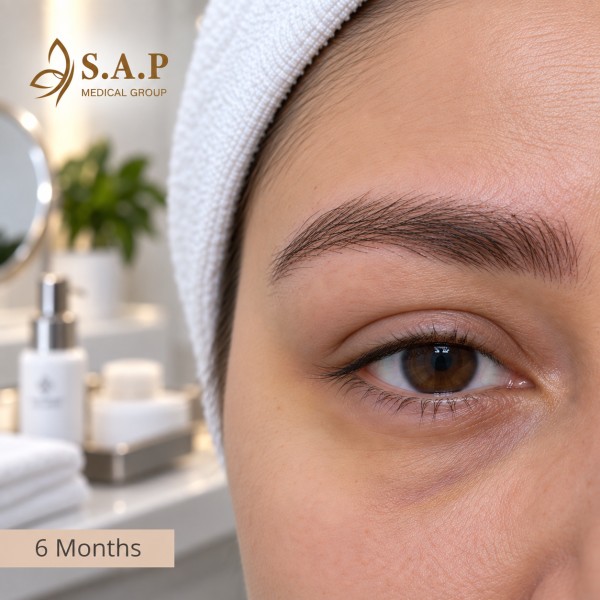
Eyebrow Transplant Results After Six Months
By approximately six months, many patients begin seeing a substantial change compared with the sparse stage experienced after shedding.
In a typical growth pattern, around 50% of the expected growth may be visible at this point.
However, this figure should never be interpreted as a strict biological deadline.
Some patients may have more than half of their expected growth by Month 6. Others may have considerably less visible growth. The thickness of individual hairs may also still be developing.
The eyebrows can therefore look noticeably improved while still appearing lighter or less dense than the final result. This is also a stage when temporary asymmetry can be particularly noticeable. One eyebrow may appear fuller than the other because individual follicles are following different growth cycles.
Patients should resist the temptation to judge the final density at this stage.
The follicles that have not yet produced visible hairs may still become active during the following months.
Eyebrow Transplant Results After Eight Months
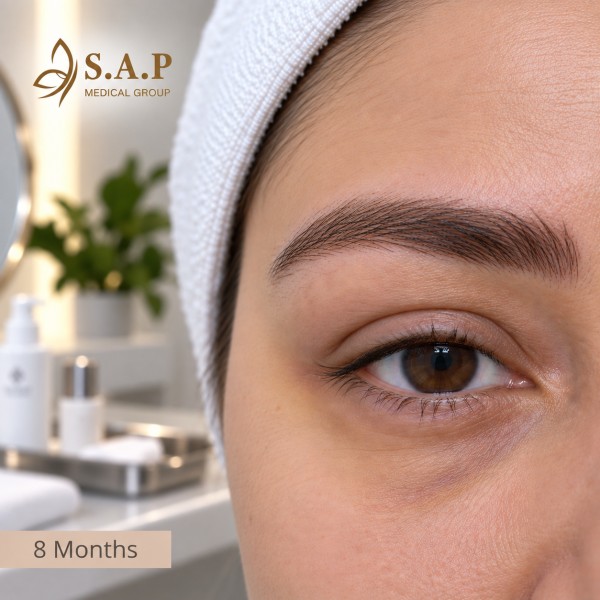
Between Months 6 and 8, many patients begin to see a more substantial transformation. In a typical case, approximately 80% of the expected result may be visible around Month 8. The eyebrows may now appear much more natural because:
- More transplanted hairs have emerged
- Existing hairs have become thicker
- Density has increased
- Hair direction has become easier to evaluate
- The transplanted hairs have begun blending more naturally with existing eyebrow hairs
However, the result can still continue developing. Some patients who experienced delayed shedding or delayed regrowth may still have significant changes ahead. This is why Month 8 should be viewed as an important milestone rather than an absolute endpoint.
Eyebrow Transplant Results After Twelve Months
Between Months 6 and 12, the eyebrows can change dramatically.
In a typical case where approximately half of the expected growth is visible around Month 6, the patient may reach roughly 80% around Month 8.
For patients whose shedding occurred early and whose regrowth began quickly, Month 8 may already represent an almost mature result.
Other patients follow a slower biological timeline.
A patient with limited growth during the first six months may only begin substantial regrowth later.
In these cases, important changes can continue through Months 10, 11, and 12.
This is why comparing two patients at exactly the same postoperative month can be misleading.
What Happens Between Months 8 and 12?
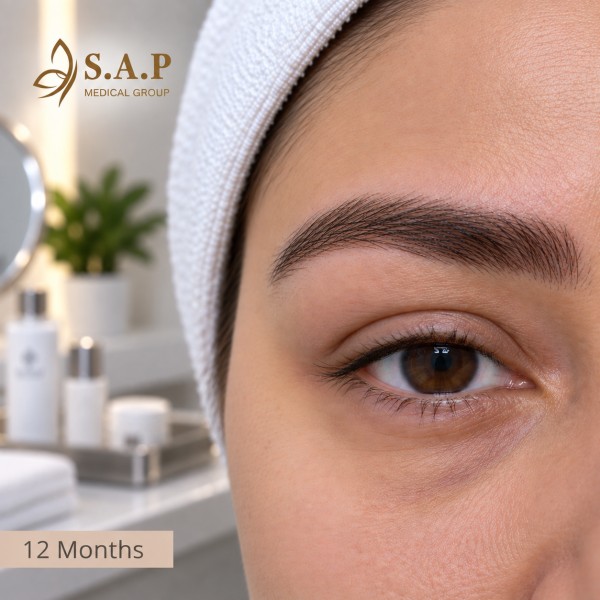
New hairs may continue to emerge while previously grown hairs become thicker and more established. A typical growth pattern may look like this:
- Around Month 6: Approximately 50% of expected growth may be visible
- Around Month 8: Approximately 80% may be visible
- Between Months 10 and 12: The eyebrows may approach their mature result
Again, these figures represent a general clinical pattern rather than a biological deadline. The Final Eyebrow Transplant Results should therefore usually be assessed only after sufficient time has passed for the individual growth cycle to mature. Only then can the medical team properly evaluate:
- Density
- Coverage
- Symmetry
- Hair direction
- Persistent sparse areas
This is also why S.A.P generally does not encourage patients to decide on a touch-up prematurely.
Are Eyebrow Transplant Results Permanent?
The objective of eyebrow transplantation is to relocate viable follicles rather than create temporary cosmetic hairs. Once successfully established, transplanted follicles can produce long-term hair growth.
However, Permanent Eyebrow Transplant Results should not be interpreted as a promise that every transplanted follicle will behave identically forever.
Hair characteristics can still be influenced over time by:
- Individual biology
- Aging
- Medical conditions
- Other changes affecting hair growth
What makes eyebrow transplantation fundamentally different from tattooing or eyebrow makeup is that the result consists of living, growing hair.
Factors That Affect Eyebrow Transplant Results
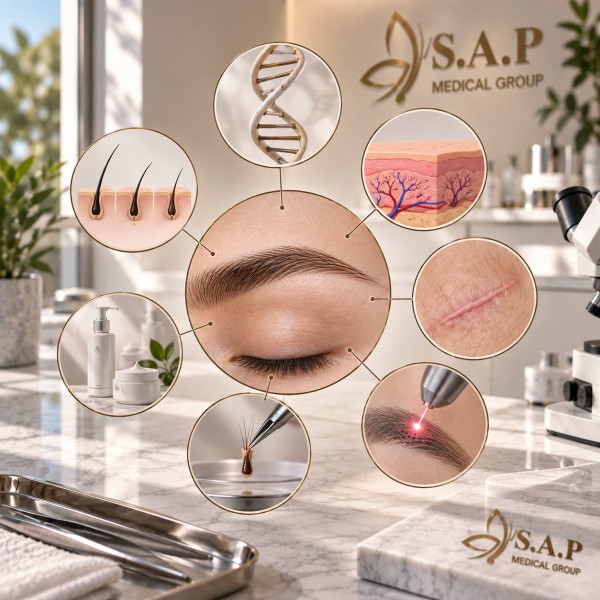
Why can two patients undergo surgery with the same team and still have completely different Eyebrow Growth Timelines? The answer lies in a combination of biological and technical factors. Several factors can influence the growth timeline, including:
- The individual's natural hair-growth cycle
- Skin quality and blood supply
- Scar tissue or previous eyebrow trauma
- Previous tattooing and laser tattoo removal
- Graft quality and microscopic preparation
- Surgical handling and ex vivo time
- Appropriate postoperative care
Patients with scarred or repeatedly treated eyebrow skin may sometimes experience slower growth. Age alone, however, should not automatically be assumed to predict slow growth. Many older patients can still experience excellent and relatively rapid regrowth.
How the Eyebrow Transplant Technique Affects Your Results
MFUE Eyebrow Transplant Results
MFUT Eyebrow Transplant Results
DHI Eyebrow Transplant Results
Eyebrow Transplant Aftercare
Proper Eyebrow Transplant Aftercare begins with following the instructions provided by the treating team. During the early healing period, patients should avoid unnecessary:
- Touching
- Scratching
- Pulling
- Rubbing
Pressure on the eyebrows during sleep should also be avoided until the grafts have stabilized. Direct and intense sun exposure is another important consideration during recovery. S.A.P generally advises patients to protect the transplanted area from direct sunlight during the first month and to follow their individualized postoperative instructions.
Good aftercare supports the healing environment and helps patients move through the different stages of eyebrow transplant recovery safely.
Frequently Asked Questions About Eyebrow Transplant Recovery
With a long-hair eyebrow transplantation technique, the planned design can be visible immediately after implantation.
However, this should not be confused with the final result.
The transplanted follicles still need to pass through their natural healing, shedding, and regrowth cycle.
The hairs are still relatively long, wet, and surrounded by temporary postoperative changes.
Small amounts of fluid or blood around the implantation sites can also temporarily make the eyebrows appear darker and denser.
Yes. Individual follicles do not necessarily enter the growth phase simultaneously.
Temporary differences between the right and left eyebrows can therefore occur.
It can be. Some patients follow a slower biological timeline and may experience significant new growth after Month 6.
The final result should not be judged prematurely.
Generally, six months is too early to make this decision. Some follicles may still be dormant beneath the skin and have not yet produced visible hairs.
It is usually better to allow the complete growth cycle to develop before evaluating whether additional transplantation is genuinely necessary.
Conclusion
Understanding Your Eyebrow Transplant Results Takes Patience
Perhaps the most important lesson about Eyebrow Transplant Results by Month is that transplantation is a biological process rather than an instant cosmetic treatment. A patient may see a new eyebrow design immediately after long-hair transplantation, lose much of that visible hair during the following weeks, pass through a temporarily sparse stage, and then watch the eyebrows gradually return over several months.
For a typical growth pattern:
- New hairs begin appearing around the third month.
- Approximately half of the expected growth may be visible around six months.
- Around 80% may be visible around eight months.
- A mature result can generally be assessed between Months 10 and 12.
But patients are not identical. Some reach their result much earlier. Others appear to progress slowly and then experience significant growth later in the year. Even the right and left eyebrows of the same patient may follow different schedules.
This is precisely why patience matters.
A successful eyebrow transplant should not be judged during the shedding phase, at Month 3, or solely on the appearance at Month 6. At SAP Medical, the complete growth journey should be evaluated before deciding whether a result is mature or whether any additional treatment is genuinely necessary.
The goal is not simply fast growth. The goal is a natural, balanced, and long-lasting eyebrow result that becomes part of the patient's face for years to come.
Why Choose
SAP Medical Group
in Istanbul?
- Experienced SpecialistsExperts with extensive eyebrow and hair transplantation experience.
- Advanced TechnologySpecialized microscopes and delicate tools for precision.
- Multilingual SupportDedicated team assisting international patients.
- Affordable ExcellenceHigh-quality treatment at competitive prices.
- Proven TransformationsExplore our gallery to see real MFUT results.
Ready to Transform Your Eyebrows?
Scheduling the Procedure First, you need to send photos of your eyebrows and the back of your head. Our consulting team will explain all the details to you. To fill out the consultation form, the doctor will ask you some questions, please answer them carefully. After reviewing your request form, if there are no contraindications, a procedure appointment will be scheduled according to your request.
No comment