


Eyebrow Transplant Recovery Timeline
Eyebrow Transplant Recovery Timeline: Day-by-Day Healing Guide
An eyebrow transplant may take only a few hours to perform, but recovery is not defined by a single day. When patients ask, “How long does eyebrow transplant recovery take?”, the answer depends on what they mean by recovery.
If they mean when they will feel comfortable enough to continue normal daily activities, many patients feel well from the following day and can perform light activities.
If they mean when the eyebrows will look sufficiently normal that other people are unlikely to notice the procedure, the answer is different.
At S.A.P, Day 12 is an important milestone in the eyebrow transplant recovery timeline. By this stage, patients can usually wash the eyebrows thoroughly, comb the longer transplanted hairs, trim them, and return to almost completely normal handling of the area.
With long-hair eyebrow transplantation, this is often when the eyebrows begin to look considerably cleaner, lighter, and more natural.
Recovery should also be distinguished from hair growth. The skin may heal and daily life may return to normal long before the transplanted follicles complete their shedding and regrowth cycle.
Medical guidance generally recognizes that eyebrow transplant recovery is relatively quick, while the final growth result takes considerably longer.

How Long Does Eyebrow Transplant Recovery Take?
There is no single Eyebrow Transplant Healing Time that applies to every part of recovery.
A patient may feel comfortable enough to answer emails, watch television, walk around the house, or perform light daily activities the day after surgery.
Returning to work, however, depends greatly on the patient's occupation.
Someone working from home may resume work almost immediately. A person whose job involves frequent face-to-face interaction may prefer to wait longer because swelling, bruising, or the unusually dark appearance of long transplanted hairs can attract attention during the first week.
A teacher, fitness instructor, driver, or person performing physically demanding work will have different recovery requirements from someone working remotely.
For patients who specifically say, “I don't want my colleagues to know I had an eyebrow transplant,” S.A.P generally recommends allowing approximately 12 days before highly visible work or important social events.
This does not mean that the patient is medically unwell for 12 days.
It means that cosmetic recovery and medical recovery are not exactly the same thing.
Eyebrow Transplant Recovery: Day 1 to Day 3
Eyebrow Transplant Day 1
Immediately after the procedure, some patients experience mild swelling while others show almost none.
This can sometimes be misleading.
Because postoperative fluid tends to move downward, a patient who looks relatively normal immediately after surgery may notice greater heaviness or swelling around the upper eyelids the following morning.
Mild asymmetry is also possible. One side may temporarily swell more than the other. This should not immediately be interpreted as an asymmetrical eyebrow design.
The transplanted eyebrows may also appear much darker than expected during the first few days.
Several factors contribute to this appearance:
Long transplanted hairs overlap one another.
Some donor hairs are naturally thicker.
The hairs may remain wet from postoperative care.
Tiny traces of blood around needle-entry sites can make the color appear deeper.
Patients who previously had very sparse eyebrows may simply be unfamiliar with seeing a fuller eyebrow.
With the long-hair approach, keeping the hairs relatively long also allows them to overlap naturally and demonstrates their intended direction.
How Should You Sleep After an Eyebrow Transplant?
During the first night, patients are generally advised to sleep with the head elevated rather than completely flat.
A slightly elevated position can help reduce the downward movement of postoperative fluid.
Patients should also avoid sleeping directly on the eyebrows.
Sleeping face-down or placing prolonged pressure on the transplanted area should be avoided during the early healing period.
Eyebrow Transplant Day 2
Day 2 can sometimes be the point at which swelling becomes more noticeable.
This is largely because fluid that was initially distributed around the forehead can gradually move downward toward the eyelids.
Patients may notice:
- Puffy upper eyelids
- A feeling of heaviness around the eyes
- Mild asymmetry
- Slight discoloration
These changes can look more dramatic than they actually are.
The eyebrows themselves should remain protected from direct pressure and unnecessary touching.
Can You Shower After an Eyebrow Transplant?
According to the postoperative protocol, patients can generally shower from Day 2.
However, the eyebrows should be washed gently.
Patients should avoid directing strong water pressure directly onto the transplanted follicles.
The donor area can usually be cleaned more thoroughly.
Water should be comfortably warm rather than very hot, and the area should not be aggressively rubbed with a towel afterward.
Eyebrow Transplant Day 3
By Day 3, swelling may still be present but should generally begin moving toward improvement.
Some patients may develop a small amount of bruising around the eyes.
This can appear as a faint blue or purple line around the eyelids.
Other patients may have almost no visible bruising.
The important point is that individual recovery varies.
Patients should not compare their Day 3 appearance with another patient's photographs and assume that their own recovery is abnormal.
Eyebrow Transplant Recovery: Day 4 to Day 7
During Days 4–7, most patients begin to notice a significant improvement in the early postoperative appearance.
Swelling continues to decrease and any mild bruising generally becomes less noticeable.
By approximately Day 7, many patients are comfortable returning to normal social and professional activities.
However, the eyebrows may still not look completely natural.
The transplanted hairs can remain relatively long and may appear darker or denser than expected.
This is especially noticeable in patients who had very little natural eyebrow hair before the procedure.
At this stage, patients should continue to follow the clinic's instructions and avoid unnecessary trimming, rubbing, or manipulation.
The temporary appearance should not be used to predict the final result.
Eyebrow Transplant Recovery: Day 7 to Day 12
The period between Day 7 and Day 12 is a transitional stage.
The skin is becoming increasingly comfortable, but the transplanted hairs are still completing the early stabilization process.
The eyebrows may begin to look somewhat untidy because the transplanted hairs continue to grow while remaining longer than a normal eyebrow.
This is one reason why some patients prefer to remain away from highly visible professional or social situations until approximately Day 12.
The important milestone comes next.
Eyebrow Transplant Recovery: Day 12
Day 12 is one of the most important points in the eyebrow transplant recovery timeline.
At this stage, patients can usually return to much more normal eyebrow care.
Depending on the individualized postoperative instructions, patients can generally:
- Wash the eyebrows thoroughly
- Massage them gently
- Comb the hairs
- Trim excessively long hairs
- Handle the area more normally
For patients who remain in Istanbul, the first professional trimming can be performed by the clinical team.
International patients can also be shown how to maintain the eyebrows safely at home.
Once the excess length is removed, the eyebrows often look significantly cleaner and more natural.
However, Day 12 also introduces another important stage: Shedding.
Eyebrow Transplant Shedding After Day 12
One of the most common concerns after eyebrow transplantation is seeing the newly transplanted hairs fall out.
This is often called shock loss or shedding.
It is important to understand that shedding of the visible hair shaft does not necessarily mean that the transplanted follicle has been lost.
The follicle remains beneath the skin and can later produce a new hair.
Shedding can occur differently in each patient.
One eyebrow may shed more than the other.
One section may shed while another section continues to show visible hairs.
Some patients may lose most of their transplanted hairs.
Others may retain a significant proportion of the visible hairs.
These differences can all occur during a normal recovery process.
Eyebrow Transplant Recovery: Week 2 to Week 4
During Weeks 2–4, many patients enter the shedding phase.
The eyebrows may look less dense than they did immediately after surgery.
This can sometimes cause patients to worry that their transplant has failed.
However, the immediate postoperative appearance is not an indication of the final density.
The transplanted follicles need time to complete their natural cycle.
Patients should therefore avoid making premature conclusions about the success of the procedure.
Temporary cosmetic products such as eyebrow pencils or powders may be used when appropriate to make sparse areas less noticeable.

Eyebrow Transplant Recovery: Month 1
By approximately one month after surgery, much of the initial visible shedding may have already occurred.
Some patients may have very few visible transplanted hairs remaining.
Others may still retain a larger percentage.
Both situations can occur.
At this stage, the follicles are preparing for the next phase of the growth cycle.
The absence of visible hair does not mean that the follicle is no longer present.
This is often one of the most psychologically challenging stages because patients may temporarily look similar to how they looked before the procedure.
Patience is essential.
Eyebrow Transplant Recovery: Month 1 to Month 3
After the initial shedding phase, there may be a period in which very little visible growth occurs.
This does not mean that nothing is happening beneath the skin.
The transplanted follicles are progressing through their biological cycle.
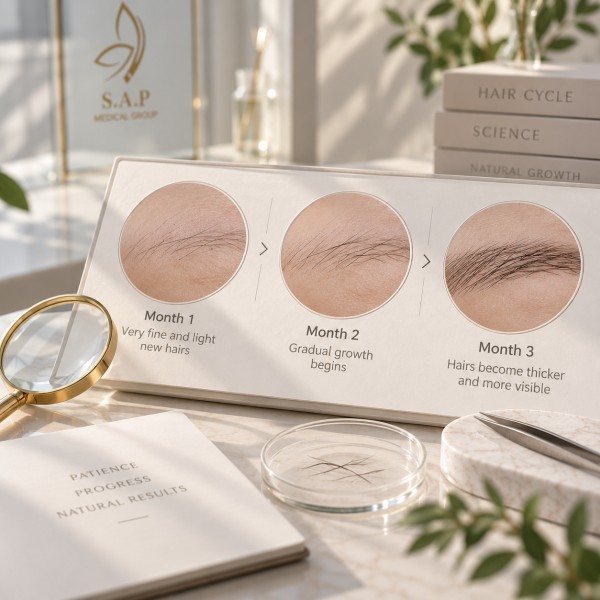
Around the third month, new growth can gradually begin.
The first hairs may be:
- Very fine
- Light in color
- Short
- Scattered
- Unevenly distributed
This is completely different from the final appearance.
The new hairs become progressively thicker and more noticeable as the growth cycle continues.
Eyebrow Transplant Recovery: Month 3
Month 3 is an important point because new growth may begin becoming visible.
However, it is still too early to evaluate:
- Final density
- Final symmetry
- Overall coverage
- Final hair thickness
Different follicles begin growing at different times.
One follicle may produce a visible hair while another remains dormant for several additional weeks.
Consequently, the eyebrows can temporarily appear uneven.
Patients should not assume that a sparse area at Month 3 will remain sparse permanently.
Eyebrow Transplant Recovery: Month 4 to Month 6
Between Months 4 and 6, the eyebrows generally become increasingly visible as more follicles enter the growth phase.
New hairs gradually become thicker and more noticeable.
By approximately Month 6, many patients may have around 50% of their expected growth visible.
However, this is only a general clinical estimate.
Some patients may have more growth.
Others may have considerably less.
A slower Month 6 result does not automatically mean that the procedure has failed.
The growth cycle can continue developing substantially after this point.
Eyebrow Transplant Recovery: Month 6 to Month 8
Between Months 6 and 8, patients often begin seeing a more significant transformation.
More follicles become active, and the existing hairs continue to mature.
Around Month 8, a typical patient may have approximately 80% of the expected result visible.
The eyebrows may now look:
- Fuller
- More balanced
- More natural
- Better integrated with existing eyebrow hair
However, individual growth can still vary.
Some patients may already look close to their final result.
Others may still have significant growth ahead.

Eyebrow Transplant Recovery: Month 8 to Month 12
The final stage of recovery is characterized by continued maturation.
New hairs may continue to emerge while existing transplanted hairs become thicker and more established.
During this period, the clinical team can evaluate:
- Density
- Coverage
- Symmetry
- Hair direction
- Hair thickness
- Remaining sparse areas
This is the period in which the final result becomes much easier to assess.
Eyebrow Transplant Recovery at Month 12
Around Month 12, the majority of patients can evaluate their final result much more accurately.
Some patients may reach a mature result earlier.
Others may continue developing beyond the one-year point.
This is particularly important for patients who experienced delayed shedding or delayed regrowth.
The final assessment should therefore consider the individual's biological timeline rather than applying a rigid deadline.

Factors That Can Affect Eyebrow Transplant Recovery
Recovery time can vary depending on several factors. Important considerations include:
- Individual healing response
- Skin characteristics
- Blood supply
- Size of the recipient area
- Number of grafts
- Graft quality
- Surgical technique
- Aftercare
- Sleeping habits
- Physical activity
- Previous eyebrow procedures
Previous tattooing, microblading, laser treatment, burns, trauma, or scarring may also influence the healing and growth environment.
Technique and Eyebrow Transplant Recovery
The harvesting and implantation technique can influence both recovery and the final growth result.
The name of the technique alone, however, does not determine the quality of the outcome.
Patients should understand how the follicles are: Harvested, Prepared, Selected, Implanted, Angled, Directed
MFUE
MFUT
DHI
Eyebrow Transplant Aftercare
Good aftercare helps protect the transplanted follicles during the early healing period.
Patients should follow the specific instructions provided by their medical team.
During the first 12 days, avoid:
- Direct pressure
- Excessive touching
- Scratching
- Rubbing
- Pulling
- Sleeping directly on the eyebrows
Patients should also avoid activities that produce excessive sweating during the recommended early recovery period. Heavy exercise and contact sports may need to be postponed for longer. Swimming and significant sun exposure should also be avoided according to the clinic's postoperative instructions.
How to Make Eyebrow Transplant Recovery Easier
A smooth recovery does not require complicated routines. The most important principles are consistency and patience. Patients should:
- Follow the clinic's washing instructions.
- Keep the area clean.
- Avoid unnecessary manipulation.
- Protect the grafts from pressure.
- Avoid excessive sweating.
- Protect the eyebrows from strong sun exposure.
- Take prescribed medication as instructed.
- Attend recommended follow-up appointments.
- Avoid judging the result too early.
- Allow the follicles enough time to complete their natural growth cycle.
When Should You Contact Your Surgeon?
Most eyebrow transplant recoveries are straightforward. However, patients should contact their medical team if they experience unexpected symptoms such as:
- Increasing rather than decreasing pain
- Significant or rapidly increasing swelling
- Persistent bleeding
- Unusual discharge
- Fever
- Increasing redness
Significant changes that appear abnormal
Patients should always follow the specific emergency and postoperative instructions provided by their clinic.
Frequently Asked Questions About Eyebrow Transplant Recovery
The initial cosmetic recovery usually takes around 12 days, while complete hair-growth recovery can continue for approximately 10–12 months.
This depends on the type of work.
Patients working remotely may return almost immediately, while people in highly visible or physically demanding roles may prefer more time.
For patients who want the procedure to be less noticeable to colleagues, approximately 12 days can be a useful planning period.
According to the postoperative protocol, gentle washing can generally begin from Day 2. The exact method should follow the instructions given by the treating clinic.
Around Day 12, patients can generally begin trimming the longer transplanted hairs according to their clinic's instructions.
Yes. Shedding is a common part of the eyebrow transplant growth cycle. The visible hair shaft can fall while the transplanted follicle remains beneath the skin.
New visible growth generally begins gradually around Month 3, although the exact timing varies from patient to patient.
Many patients may have around 50% of their expected growth visible by Month 6. However, some patients develop faster or slower.
The result generally becomes much easier to evaluate between Months 10 and 12. Some patients may reach their mature result earlier, while others may continue to develop after one year.
Conclusion
Eyebrow Transplant Recovery Is a Gradual Process
An eyebrow transplant may be completed within a few hours, but the biological recovery process continues for many months.
The first few days are primarily about controlling swelling and protecting the newly implanted follicles.
The first week is mainly a healing period.
Day 12 is an important milestone because patients can usually begin washing, brushing, trimming, and handling the eyebrows much more normally.
Weeks 2–4 may bring shedding.
Month 1 can temporarily appear sparse.
Around Month 3, new growth may begin.
By Month 6, approximately half of the expected growth may be visible in a typical case.
Around Month 8, approximately 80% may be visible.
Between Months 10 and 12, the eyebrows can approach their mature result.
The most important point is that every patient follows an individual recovery timeline.
Temporary shedding, uneven growth, differences between the two eyebrows, and slow early development do not automatically indicate a failed transplant.
The best approach is to protect the grafts during the early healing period, follow the aftercare instructions carefully, and allow sufficient time for the transplanted follicles to complete their natural growth cycle.
At S.A.P, the goal is not simply to make the eyebrows appear fuller as quickly as possible. The objective is to achieve a natural, balanced, and long-lasting eyebrow result while giving each follicle the time it needs to develop properly.
Why Choose
SAP Medical Group
in Istanbul?
- Experienced SpecialistsExperts with extensive eyebrow and hair transplantation experience.
- Advanced TechnologySpecialized microscopes and delicate tools for precision.
- Multilingual SupportDedicated team assisting international patients.
- Affordable ExcellenceHigh-quality treatment at competitive prices.
- Proven TransformationsExplore our gallery to see real MFUT results.
Ready to Transform Your Eyebrows?
Scheduling the Procedure First, you need to send photos of your eyebrows and the back of your head. Our consulting team will explain all the details to you. To fill out the consultation form, the doctor will ask you some questions, please answer them carefully. After reviewing your request form, if there are no contraindications, a procedure appointment will be scheduled according to your request.
No comment