

Combined Eyebrow, Beard and Targeted Hair Restoration
Combined Eyebrow, Beard and Hair Restoration
Combined restoration allows suitable patients to treat the eyebrows, beard, mustache or selected scalp areas within one coordinated plan. Depending on graft requirements, donor capacity and the patient’s condition, treatment may be completed in one day, on two consecutive days or at separate appointments. At S.A.P, every Eyebrow, Beard and Hair Transplant plan is personalized, with a primary focus on eyebrow transplantation and carefully selected beard and scalp cases.
Personalized Restoration for Multiple Areas
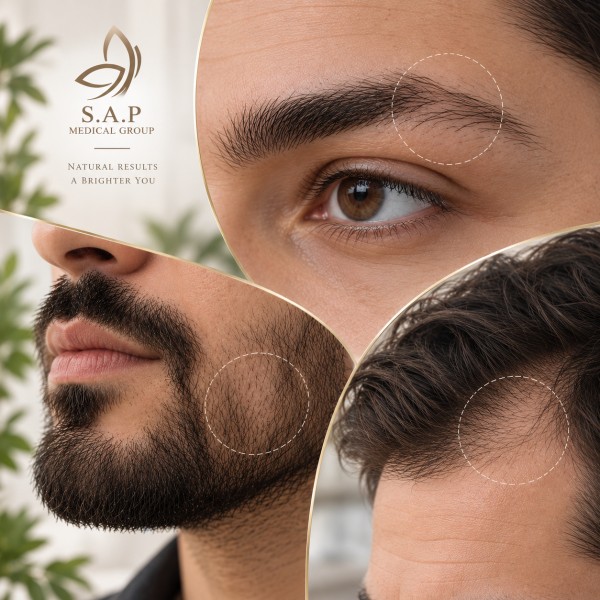
Hair loss does not always affect only one area. A patient may have sparse eyebrows with an uneven beard, or need eyebrow restoration together with treatment of a bald patch, scar or receding scalp area. Combined Hair Restoration allows these concerns and the available donor supply to be evaluated together.
The purpose is not simply to harvest as many grafts as possible. Each area has different requirements. Eyebrow hairs need a very flat angle and carefully changing directions. Beard and mustache hairs require a pattern that follows the natural direction and density of each part of the face. Scalp restoration must consider the existing hairline, surrounding density and the possible progression of hair loss.
Before approving an Eyebrow, Beard and Hair Transplant, we assess the type and stability of hair loss, the condition of the skin, the quality of the donor area and the number and structure of the available follicular units. This helps us distribute the donor grafts realistically and select the appropriate harvesting and implantation approach for every treatment area.
Combined Treatment Options
Eyebrow + Beard Restoration
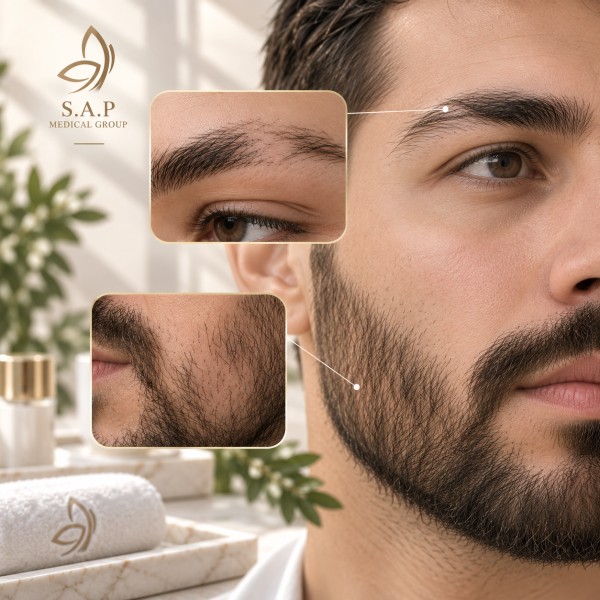
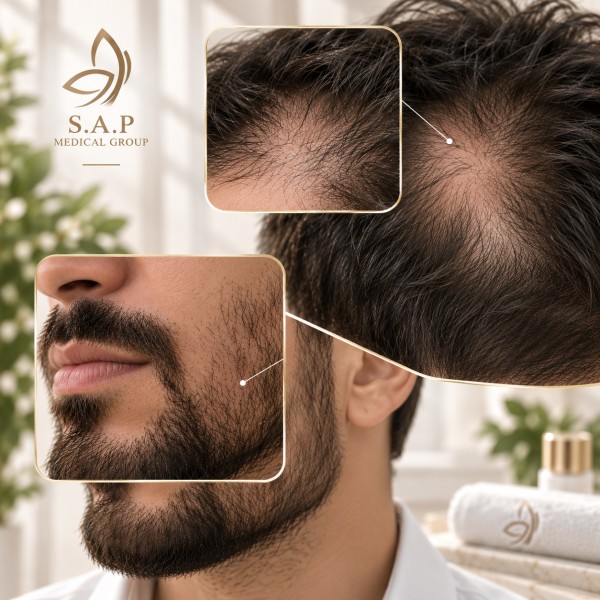
An Eyebrow and Beard Transplant may be appropriate for a patient who wants to restore sparse eyebrows while improving an incomplete beard or mustache. This form of Eyebrow, Beard and Hair Transplant planning may involve full facial-hair reconstruction, scattered gaps, cheek or jaw lines, one side of the face, congenital absence, injury or scarring.
Beard grafts are generally harvested using follicular unit extraction (FUE). According to the treatment plan, the recipient channels are opened first using either sapphire blades or surgical blades manufactured by Swann-Morton. The grafts are then placed into those channels with fine forceps. This channel-first, forceps-placement approach is different from DHI. Direction control is particularly demanding in beard transplantation because the angle and orientation of the hair change across the mustache, cheeks, jaw and chin.
Microscopic preparation is not routinely required for every beard graft. It may be used selectively when many units contain three or four hairs and would look too heavy. Where their structure permits safe separation, suitable units may be divided under magnification into smaller one- or two-hair grafts. This does not create additional hairs; it creates more implantable units for a more refined distribution. It may also help when donor supply is limited and careful placement is needed for visual coverage.
Eyebrow + Scalp Hair Restoration
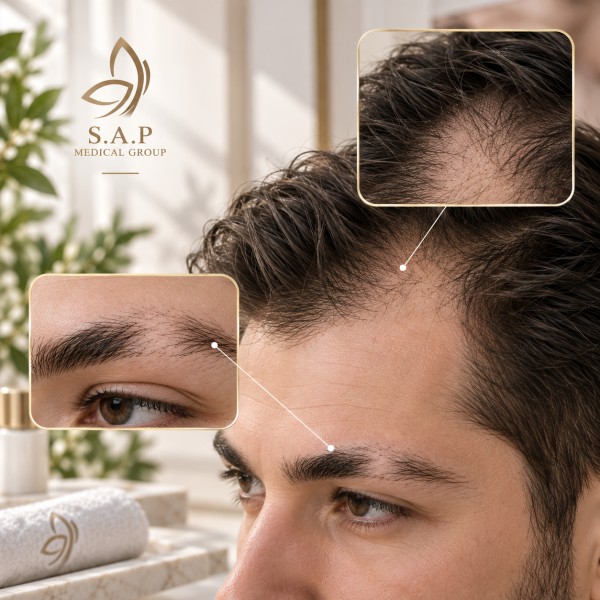
An Eyebrow and Hair Transplant can combine eyebrow restoration with a standard scalp procedure or treatment of the temples, frontal hairline, localized thinning or a scar. Planning must consider the graft requirements and the different hair characteristics needed for each area.
FUE harvesting may supply grafts for both areas when the patient accepts shortening part of the donor hair; however, the eyebrow grafts undergo additional microscopic inspection and preparation as part of the MFUE approach. Although their shafts are short, the new outline can be seen immediately. They continue growing and usually become clearly visible by approximately day 12, around the time the expected shedding phase may begin.
In selected combined cases, two harvesting methods may be used. For example, FUE may supply scalp grafts while microscopic follicular unit transplantation (MFUT) provides long grafts for extensive eyebrow work. When only a small number of long eyebrow grafts is required, Long FUE may be an alternative.
Beard + Scalp Hair Restoration
A Beard and Hair Transplant may combine beard correction with standard or targeted scalp restoration. The donor area is treated as one shared, limited resource, and grafts are allocated according to area size, hair characteristics and realistic density.
FUE is generally preferred for male patients because FUT may leave a linear donor scar. Even when healing is good, the line may be around 2 mm wide and could become visible if the patient later shaves the scalp or wears the hair very short. If a patient strongly prefers long-hair harvesting and accepts the possibility of a visible linear scar, FUT can still be discussed after an individual assessment.
Multiple-Area Restoration
Some patients may need Multiple Area Hair Restoration involving more than two regions. An Eyebrow, Beard and Hair Transplant may include both eyebrows, limited facial-hair areas and a selected part of the scalp. This requires careful donor management, a clear indication for each area and realistic graft allocation.
Targeted Restoration for Small Areas of Hair Loss
S.A.P has a particular interest in precise restoration of small and visible areas. Hair Transplant for Small Areas may be considered for localized scalp thinning, a stable bald patch, a sparse section of the beard, missing eyebrow hair or hair loss associated with a suitable scar.
A Small Area Hair Transplant is not necessarily simple. A visible defect may require exact direction, fine graft selection and careful blending. Localized Hair Restoration is planned according to its shape, skin condition and blood supply, existing hair directions and safe graft capacity.
The objective is targeted improvement rather than unnecessary expansion of the treatment area. This approach distinguishes S.A.P’s positioning in selected scalp and facial restoration cases.
S.A.P coordinates standard scalp hair transplantation through appropriately authorized medical facilities and experienced teams. However, the main focus of our website and professional services is specialized eyebrow transplantation, combined procedures and selected cases requiring targeted restoration of the scalp or beard.
Patients with Extensive Hair Loss or Extensive Scalp Baldness can still request an assessment. Donor capacity, hair-loss pattern, expectations and likely progression are reviewed. A Large-Scale Hair Transplant may sometimes be possible, but donor hair may be insufficient for the requested scalp coverage plus eyebrow or beard restoration. These limitations are explained without guaranteeing full coverage.
Our Approach to Extensive Scalp Baldness
Patchy Hair Loss and Scar Restoration
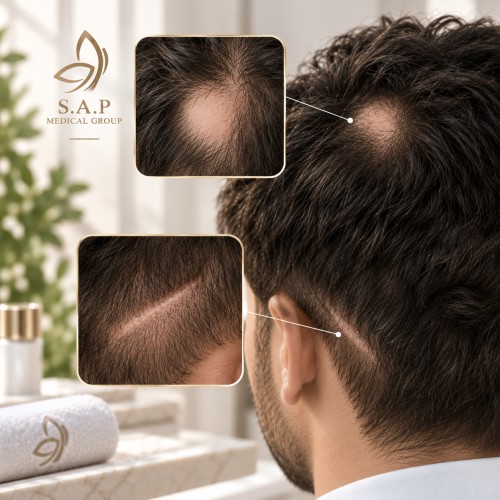
Patchy Hair Loss Restoration may be considered for small, stable areas affected by previous injury, burns, surgery or certain forms of localized hair loss. Scar Hair Restoration requires careful examination because scarred skin may differ in thickness, stiffness and blood supply. Graft numbers and expected density must therefore be planned conservatively.
Alopecia areata requires particular caution because transplantation does not treat the underlying autoimmune disease. Selected cases may be considered only after medical assessment confirms stability and no evidence of active loss. “Alopecia Areata Hair Transplant” must not be presented as a general promise; suitability depends on diagnosis, duration of stability, skin condition and medical review.
One-Day or Two-Day Combined Procedures
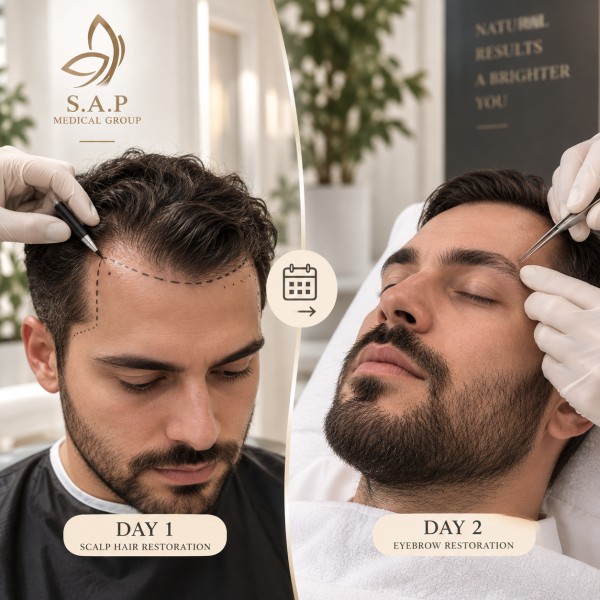
Some treatments can be completed in one session when the areas are limited, graft requirements are manageable and the patient remains clinically comfortable. In other cases, an Eyebrow, Beard and Hair Transplant or another Combined Hair Transplant Procedure is safer and more practical when divided into two days.
The schedule is not decided by graft count alone. Procedure duration, bleeding, blood pressure, patient fatigue and the safe cumulative limits of local anesthetic and epinephrine must all be considered. If the clinical team determines that continuing is not appropriate, eyebrow implantation can be postponed until the following day or another suitable date.
A patient living in Istanbul or planning a longer stay may rest after scalp treatment and return several days later for eyebrow restoration. A Two-Day Hair Transplant does not necessarily mean two consecutive days. The schedule protects safety, graft quality and comfort.
How Your Treatment Plan Is Designed
Every Eyebrow, Beard and Hair Transplant plan follows four essential stages:
- Medical assessment:We review the type and stability of hair loss, relevant diseases, medications, previous procedures and the condition of each proposed recipient area.
- Donor-area evaluation:Hair density, follicular-unit structure, shaft thickness and available donor capacity are assessed.
- Treatment planning:The required areas, estimated graft distribution, eyebrow or beard design, harvesting method and implantation approach are selected.
- Personalized procedure schedule:The treatment is planned for one day, two days or separate appointments according to its extent and the patient’s clinical needs.
Why Choose
SAP Medical Group
in Istanbul?
- Expert SpecialistsDecades of combined eyebrow transplantation experience.
- Advanced TechnologyMicro-punch tools for precise, scar-free extraction.
- International Patient CareMultilingual team support at every step.
- Affordable PackagesHigh-quality treatments at globally competitive rates.
- Proven Results Real patient transformations available in our gallery.
Is Combined Hair Restoration Right for You?
An Eyebrow, Beard and Hair Transplant may be suitable when more than one area has a genuine and stable need for restoration, sufficient donor hair is available and the patient understands the realistic limits of density and coverage. Suitability depends on the type of hair loss, treatment-area size, skin condition, donor capacity, medical history and individual goals.
Combined treatment may offer one coordinated plan and, in suitable cases, a shared recovery period. Nevertheless, combining procedures is not automatically the best choice for everyone. Safety, natural direction, donor preservation and long-term appearance remain more important than completing every requested area in a single session.
To receive an individual Eyebrow, Beard and Hair Transplant assessment, send clear photographs of the eyebrows, beard or mustache, relevant scalp areas and the donor area. Following evaluation, the S.A.P team can recommend a suitable Combined Hair Restoration plan, harvesting method, estimated graft distribution and schedule.
No comment