

Golden Tips for Microscopic Eyebrow Transplantation
Golden Tips for Microscopic Eyebrow Transplantation: Microscopic eyebrow transplantation is not simply an eyebrow transplant performed beside a microscope. The microscope must be used purposefully to inspect, prepare and classify every graft before implantation. Proper temperature control, continuous hydration, efficient dissection, preservation of protective tissue, single-hair graft selection and careful matching of hair thickness and curvature can all influence the final appearance.
At S.A.P Medical Group, microscopic graft preparation is an essential part of our MFUE and MFUT eyebrow transplant approaches. The goal is not merely to produce a large number of grafts, but to preserve the patient’s limited donor supply and prepare suitable single-hair units for a soft, natural eyebrow design.
1. Protect Every Graft Immediately After Harvesting
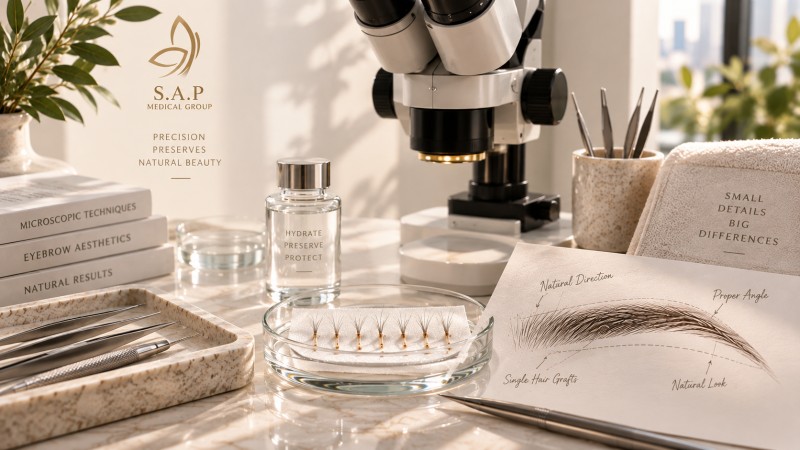
Hair follicles are living tissue and must be protected from the moment they are removed from the donor area. After harvesting, the grafts are placed promptly in an appropriate isotonic solution. In the S.A.P protocol, they are maintained in a controlled, cool environment of approximately 2–6°C while awaiting preparation and implantation.
The required temperature may be maintained with a dedicated cooling system or a carefully prepared environment using ice packs. Cooling must remain controlled. The purpose is to protect the grafts during their time outside the body—not to freeze them or expose them to uncontrolled temperature changes.
For the patient, this stage is invisible, but it is one of the first steps in protecting graft quality.
2. Never Allow Grafts to Dry Under the Microscope
Microscopic preparation requires time and concentration. During this stage, grafts remain outside the body and can lose moisture if they are neglected. The technician must repeatedly moisten them with the appropriate isotonic solution throughout the preparation process.
The microscope itself does not protect a graft from dehydration. Good results depend on the person using it. Leaving tissue exposed on the work surface without regular hydration may compromise graft quality. An organized technician prepares small groups efficiently, keeps them continuously moist and returns prepared grafts to the cooled holding solution without unnecessary delay.
3. Work Efficiently—but Never Carelessly
Speed matters in microscopic graft preparation because unnecessarily long processing increases the time that follicles remain outside the body. However, speed should never mean rushing.
An experienced technician develops a balance between efficiency and precision. Working too slowly may prolong handling, while working too quickly without control can cut, crush or over-trim the follicles. A well-trained team organizes the grafts, instruments and holding solution before dissection begins so that every step proceeds smoothly.
This balance becomes especially important when hundreds of eyebrow grafts must be prepared. The aim is to produce the required number of healthy, usable grafts while minimizing unnecessary manipulation.
4. Preserve the Protective Tissue Around the Follicle
Under magnification, excess skin and fatty tissue can be removed to create a finer graft that is suitable for delicate eyebrow implantation. But a graft should not be stripped excessively.
The follicular bulb, papillary region and surrounding protective tissue can be examined under the microscope. Enough tissue must remain around the important structures of the follicle to protect it during handling and implantation. Removing too much tissue may make the follicle more vulnerable to drying, forceps pressure and physical damage.
The objective is therefore not to create the thinnest possible graft at any cost. It is to create a refined graft while preserving the structures required for safe transplantation.
5. Evaluate Graft Integrity, Not Just Graft Numbers
The microscope provides a detailed view of follicular structure and visible signs of damage. The team can identify grafts that appear transected, crushed, excessively stripped or otherwise unsuitable for eyebrow implantation.
Previous conditions affecting the donor area may also influence graft quality. Long-term traction from hair extensions, for example, may damage some follicles. A history of scalp inflammation may leave follicles with abnormal or weakened morphology even after the visible inflammation has resolved. Features associated with different stages of the hair-growth cycle may also be observed under magnification.
Microscopic examination cannot guarantee whether an individual graft is biologically “alive” or predict its future growth with certainty. It does, however, allow visibly compromised grafts to be recognized and excluded instead of being implanted merely to increase the reported graft count.
6. Use Only Single-Hair Grafts for the Eyebrows
Natural eyebrow hairs emerge individually. For this reason, S.A.P uses single-hair grafts for eyebrow transplantation.
Follicular units harvested from the scalp may contain two, three or more hairs. Where their structure permits safe separation, suitable multi-hair units can be divided under the microscope into individual grafts. This requires technical skill because careless separation may cut or damage the follicles.
Using single-hair grafts gives the implantation team greater control over spacing, direction and the relationship between neighboring hairs. It also helps prevent the heavy, plug-like appearance that may occur when multi-hair units are placed into a delicate eyebrow design.
7. Match Hair Thickness, Shape and Natural Curvature
Not all scalp hairs have the same thickness or curve. Some are fine, while others are coarser. Some shafts are relatively straight, while others have a visible natural bend. These characteristics must be considered together with the patient’s chosen eyebrow model.
A natural result is not achieved by placing every fine hair in one section and every coarse hair in another. This can create obvious transitions between zones. Instead, hairs of different thicknesses are distributed in a carefully blended pattern so that density and texture change gradually.
The natural shape of each shaft also matters. A curved hair must be selected and positioned according to the area in which it will be implanted. During placement, each graft is rotated as necessary so that its natural curve follows the intended direction and lies appropriately within the eyebrow design.
8. Respect the Changing Direction of the Eyebrow
An eyebrow is not a straight row of hairs. Direction changes from the inner portion through the body, arch and tail. Even a healthy single-hair graft may look unnatural if its curve or orientation does not match the neighboring hairs.
Microscopic classification helps the team organize grafts according to thickness and shaft characteristics before implantation. The implantation team can then select and rotate each graft for its intended position.
This connection between microscopic preparation and precise placement is essential: excellent preparation cannot compensate for poor implantation direction, and skilled implantation cannot fully correct badly selected grafts.
9. Adapt Microscopic Preparation to the Harvesting Method
In MFUE eyebrow transplantation, follicular units are extracted individually from a shortened donor area. The shafts are short, but the extracted eyebrow grafts still undergo microscopic inspection, refinement and conversion into suitable single-hair units.
In MFUT eyebrow transplantation, a narrow donor strip is removed while the surrounding hair remains long. The follicular units are separated from the strip under specialized microscopes. Because the shafts remain long, their thickness, curvature and immediate relationship with the eyebrow design can be observed more easily.
Both approaches require microscopic judgment. The harvesting method may change, but the principles of hydration, tissue preservation, graft selection and single-hair preparation remain essential.
10. Protect the Patient’s Limited Donor Supply
Donor hair is a limited biological resource. Poor microscopic technique can waste follicles through transection, excessive trimming, crushing, dehydration or incorrect separation.
This loss may have a direct effect on the donor area. If a technician cannot obtain enough usable grafts from the harvested tissue, a larger donor area may be required to reach the same planned graft number.
For example, tissue that should provide the required grafts with efficient dissection may produce far fewer usable units when handled poorly. The exact donor dimensions vary according to hair density, follicular structure and individual anatomy, but the principle remains the same: better graft preservation means less unnecessary donor waste.
Patients should therefore ask not only how many grafts will be transplanted, but also how those grafts will be prepared and protected.
What Should a Patient Ask Before a Microscopic Eyebrow Transplant?
Before choosing a treatment team, consider asking:
- Are eyebrow grafts examined under specialized microscopes?
- Who prepares the grafts, and how much eyebrow-specific experience does that person have?
- Are grafts kept cool and continuously hydrated?
- Are multi-hair follicular units safely converted into single-hair grafts?
- Are visibly damaged grafts excluded?
- How are hair thickness and natural curvature matched to the eyebrow design?
- Is every graft rotated and placed according to the changing direction of the eyebrow?
- How does the team minimize unnecessary waste of donor hair?
These questions help patients distinguish genuine microscopic graft preparation from the use of “microscopic” only as a marketing term.
Final Thoughts
The microscope is a valuable instrument, but the quality of microscopic eyebrow transplantation ultimately depends on the knowledge, speed, precision and discipline of the team using it. Temperature control, continuous hydration, preservation of protective tissue, careful assessment, single-hair preparation and artistic graft distribution must work together.
At S.A.P Medical Group, the purpose of microscopic preparation is not simply to make grafts smaller. It is to protect the donor hair, exclude visibly unsuitable grafts and prepare individual hairs that can be blended, rotated and implanted according to the patient’s eyebrow design.
For a personalized assessment, patients can send clear photographs of their eyebrows and donor area. The S.A.P team can then evaluate the eyebrow condition, donor-hair characteristics and the most appropriate microscopic eyebrow transplantation method for the individual case.
Why Choose
SAP Medical Group
in Istanbul?
- Expert SpecialistsDecades of combined eyebrow transplantation experience.
- Advanced TechnologyMicro-punch tools for precise, scar-free extraction.
- International Patient CareMultilingual team support at every step.
- Affordable PackagesHigh-quality treatments at globally competitive rates.
- Proven Results Real patient transformations available in our gallery.
Ready to Transform Your Eyebrows?
Take the first step toward full, natural-looking eyebrows with SAP Medical Group. Our specialists provide personalized consultations and guide you through every step of the procedure.
No comment