

Eyebrow Transplant Aftercare
Eyebrow Transplant Aftercare Day by Day: A Practical Guide for Safe Healing
Eyebrow transplant aftercare is an important part of treatment. During the first days, delicate grafts placed at carefully planned angles and directions must be protected from pressure, friction, scratching, and unnecessary contact. This guide explains how to care for the eyebrows and donor area, when to wash, how to sleep, which activities to avoid, and when to contact the clinic.
Eyebrow Transplant Aftercare at a Glance
For the first 12 days, do not touch, rub, scratch, massage, or sleep on the transplanted eyebrows. Keep your head elevated while resting and avoid prolonged bending. Take prescribed medication and use the recommended saline spray. You may shower from day two, but do not expose the eyebrows to direct water pressure. Full face washing, gentle massage, and trimming usually begin on day 12. Light exercise may then resume; heavy exercise, swimming, and sauna should wait approximately one month.

Why the First 12 Days Matter
Immediately after transplantation, every graft is held in a very small recipient site. The grafts gradually become secure as the skin heals around them. Contact that may seem harmless—such as rubbing the forehead, pulling clothing over the face, using an eye mask, resting the face on a pillow, or repeatedly touching the area—can disturb the grafts during this sensitive period.
Small crusts, mild redness, tenderness, and limited swelling may occur. These changes are generally part of early healing and should improve gradually. Do not pick the crusts or try to make the eyebrows look clean before the recommended washing stage. Removing them too early may injure the skin or displace a graft.
The First 48 Hours
Rest after returning home and keep the head elevated. Avoid sleeping face-down or putting pressure on either eyebrow. A supportive pillow can help maintain a safer position.
Do not touch the eyebrows to check whether the grafts are secure. Avoid scratching, tight hats, eye masks, towels, or clothing that may brush against them. Limit prolonged bending and activities that keep the head below heart level, as these can increase swelling.
Wash the rest of the face carefully without allowing water, cleanser, or a towel to contact the grafts. Use the provided saline spray as instructed by the S.A.P team. Take prescribed products only according to your individual instructions.
The donor-area dressing is generally removed after two days, following the clinic’s directions. Do not remove it early or pull it across the transplanted eyebrows.
Daily Care and Activities After Eyebrow Transplantation
Washing and Showering
Patients may shower from day two, but direct water pressure must not reach the eyebrows. Avoid hot water, steam, scrubbing, and exfoliating products. Until day 12, wash the surrounding face carefully without touching or rubbing the grafts. Follow the clinic’s recommended washing products and instructions. Around day 12, the grafts are normally secure enough for gentle washing and massage to remove remaining crusts. Transplanted hairs may also be carefully trimmed with scissors when advised.
How to
Sleep Safely
For 12 days, sleep on your back with the head slightly elevated. Do not sleep on your face, press an eyebrow into the pillow, or rest your forehead on your hand. Avoid eye masks during this period unless the clinical team has specifically approved one that cannot touch the grafts. Use a fresh pillowcase and take care not to rub the brows with bedding. After day 12, normal sleeping positions can usually be resumed gradually if healing is satisfactory.
Sun, Makeup, and Daily Activities
Protect the transplanted area from direct sunlight for at least two weeks. Sunglasses may be worn if they do not touch or compress the eyebrows. Do not apply sunscreen directly over fresh grafts unless the clinic has approved the product and timing. Makeup or concealer may be used on surrounding facial areas provided it does not touch the transplanted eyebrows. Products should not be applied directly to healing recipient sites during the early period. When removing makeup, avoid rubbing near the brows.
Exercise, Swimming, and Sauna
Avoid exercise and activities that cause heavy sweating during early healing. Light exercise can generally restart after day 12 if there is no unusual redness, pain, or swelling. Heavy workouts, swimming pools, the sea, sauna, steam rooms, and similar activities should usually be postponed for approximately one month. Individual instructions may differ according to healing, medical history, and whether another procedure was performed at the same time.
Donor-Area Aftercare
Donor care depends on the harvesting method. MFUE or Long FUE creates small distributed extraction points; MFUT involves a narrow strip closed with sutures. Follow the clinic’s method-specific instructions.
Keep the donor area clean, avoid scratching, and do not apply oils, creams, hair dye, or unapproved treatments. Do not remove crusts or interfere with sutures. If MFUT was used, attend the recommended review or suture-removal appointment. Contact the clinic if the donor area develops increasing pain, marked redness, discharge, bleeding, or separation of the wound edges.
Shedding Does Not Mean the Transplant Has Failed
From approximately day 12 through the first month, many transplanted hair shafts shed. This is expected and does not usually mean the follicle has been lost. The roots remain under the skin and enter a resting phase.
New growth generally begins around month three. Approximately half may be visible by six months, with substantial development by month eight. The result continues to mature for 12 months. Because grafts originate from scalp hair, regular scissor trimming may be needed.
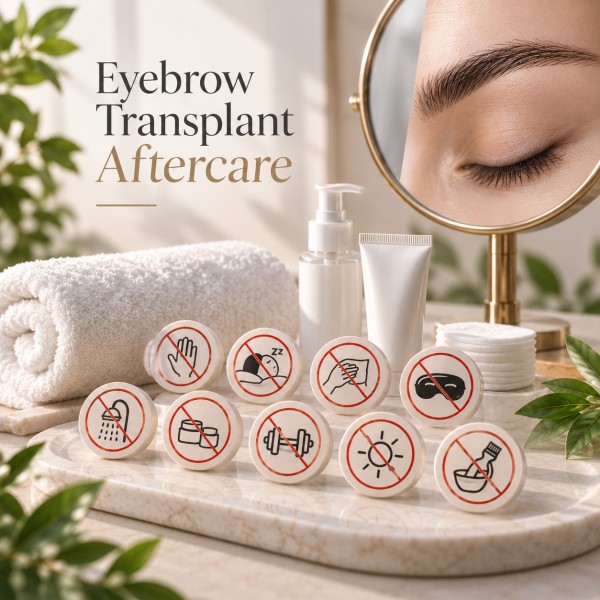
What Should Be Avoided?
- Touching, rubbing, scratching, or picking the eyebrows
- Sleeping face-down or pressing the brows against a pillow
- Resting the forehead or eyebrow area on the hand
- Eye masks or tight accessories that contact the grafts
- Direct shower pressure, hot water, steam, and vigorous washing
- Unapproved creams, oils, antiseptics, or cosmetic treatments
- Heavy exercise, swimming, sauna, and excessive sweating too early
- Direct sun exposure during the first two weeks
- Hair dye or chemical products on the donor area before approval
Mild swelling, small crusts, limited redness, and some itching can occur during normal healing. Contact the clinic if symptoms are severe, worsening, or unusual—particularly increasing redness, significant swelling, persistent or increasing pain, discharge, fever, heavy bleeding, wound separation, or severe itching.
If an eyebrow is accidentally hit, rubbed, or scratched, do not try to replace or manipulate a graft yourself. Send clear photographs and explain what happened so the clinical team can advise you.
When Should You Contact the Clinic?
Follow-up and Long-Term Care
Follow-up photographs help the team evaluate healing, shedding, new growth, direction, and density. Patients can also receive trimming guidance.
Every patient heals differently. Skin quality, previous tattooing or laser treatment, scar tissue, circulation, graft quality, and adherence to aftercare can influence the process. For this reason, individual instructions from the treating team always take priority over general online advice.
Careful eyebrow transplant aftercare protects the work completed during the procedure and gives each graft the best possible environment for healing. The essential rules are simple: keep the area clean as instructed, avoid pressure and manipulation, wait until day 12 before full washing and trimming, delay strenuous activities, and remain in contact with the clinic whenever something feels unusual.
Following these instructions consistently also helps reduce preventable irritation and makes the early healing period easier and more predictable.
It also gives patients clear expectations, helping them avoid unnecessary worry about normal crusting, temporary shedding, and the gradual pace of regrowth.
Frequently Asked Questions
The most important step is protecting the transplanted area during the first 12 days. Avoid touching, scratching, or applying pressure so the grafts can heal properly and deliver natural-looking results.
Keep your head slightly elevated with extra pillows for the first few nights. This reduces swelling and prevents accidental pressure on the eyebrows during sleep.
You can start gently washing your face the next day using only lukewarm water and prescribed solutions. Avoid rubbing or using towels directly on the eyebrow area for at least 12 days.
Avoid heavy exercise, swimming, saunas, or any activity that causes sweating for the first 12 days. These can harm the new grafts and delay healing.
Final eyebrow transplant results are generally evaluated at approximately 12 months, although individual growth and maturation may vary.
Why Choose
SAP Medical Group
in Istanbul?
- Expert SpecialistsDecades of combined eyebrow transplantation experience.
- Advanced TechnologyMicro-punch tools for precise, scar-free extraction.
- International Patient CareMultilingual team support at every step.
- Affordable PackagesHigh-quality treatments at globally competitive rates.
- Proven Results Real patient transformations available in our gallery.
Ready to Transform Your Eyebrows?
Scheduling the Procedure First, you need to send photos of your eyebrows and the back of your head. Our consulting team will explain all the details to you. To fill out the consultation form, the doctor will ask you some questions, please answer them carefully. After reviewing your request form, if there are no contraindications, a procedure appointment will be scheduled according to your request.
No comment